Best Juicers Guide
The Guide · Juicers for Home Kitchens

The 150-watt juicer here is the one built for kale.

KOIOS rates its centrifugal juicer at 1,300 watts. Ninja rates the auger in its NeverClog cold press at 150, and lists celery and leafy greens among the produce it is made for. If watts measured juicing, that would make no sense. The two machines work in opposite ways. A centrifugal juicer shreds produce on a cutting disc that the fastest listings here rate at 18,000 RPM, then flings the juice through a mesh basket, which takes a fast, hungry motor. A masticating juicer crushes produce with a screw-shaped auger turning at 50 to 65 RPM on the listings that publish it, and a gearbox trades speed for force. Wattage tells you which kind of juicer you are looking at, not how much juice it presses from a bunch of kale. What decides the purchase is the extraction type, the chute, the daily cleanup and the warranty. We compared published specifications, manufacturer data and current Amazon prices for 33 electric juicers sold in the US.

By Ilane Tall6 picks · 33 juicers comparedResearch-based — no testing lab, no invented scores

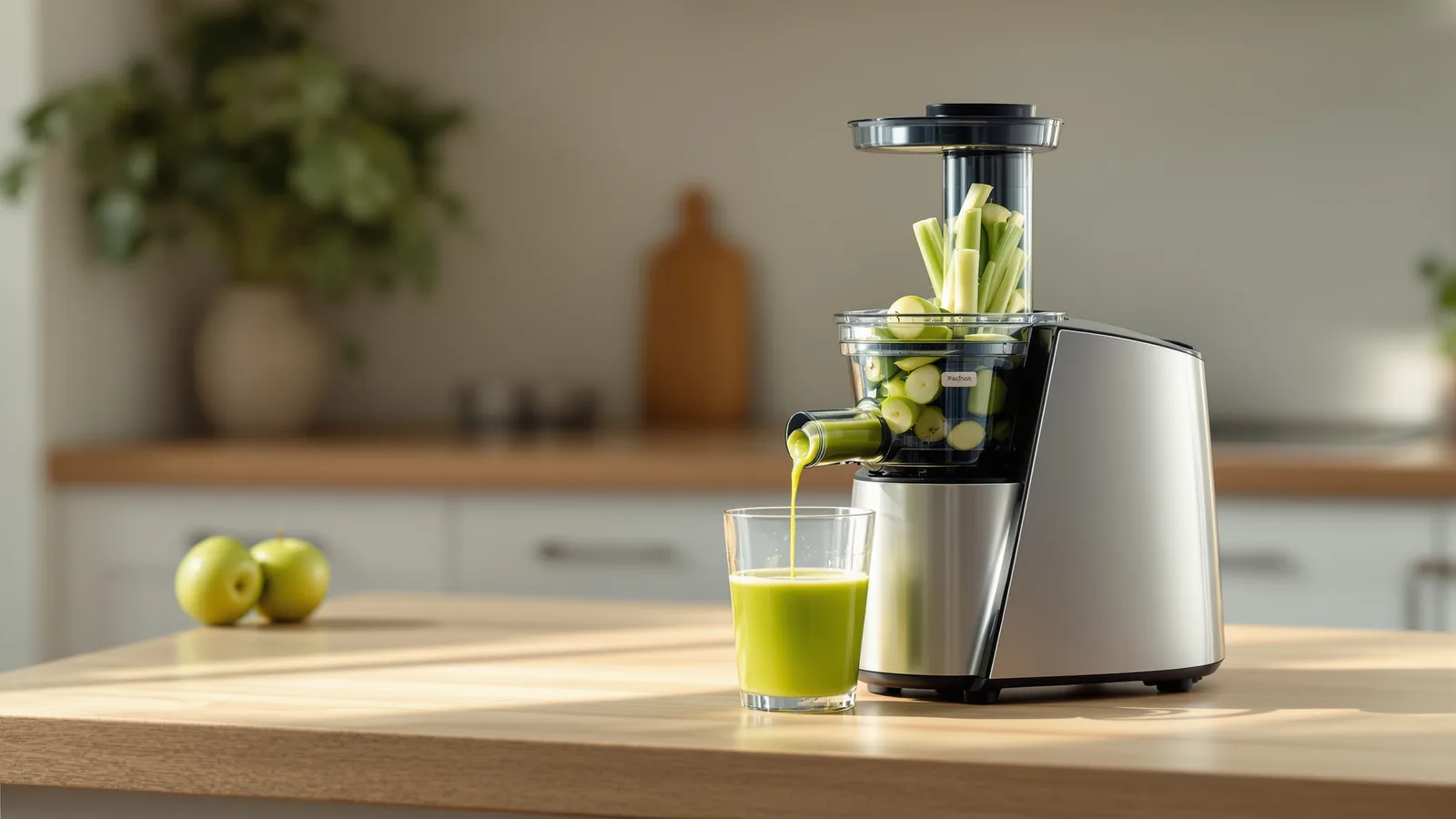
Slow cold press juicer with whole green apples and celery in its tall clear feed hopper beside a glass of green juice on a pale oak kitchen counter
The one to buy

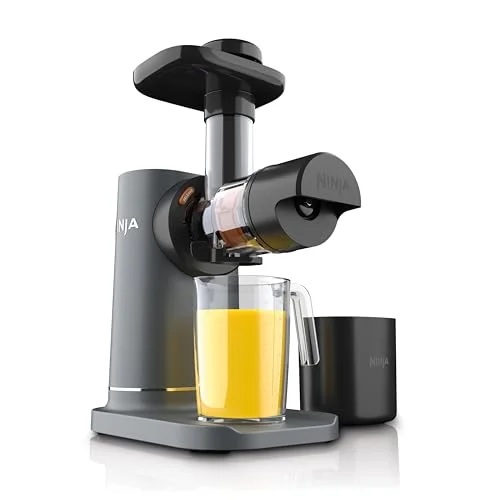
Ninja NeverClog Cold Press Juicer

The NeverClog is the juicer we would hand to someone who wants to juice greens as well as fruit, and still be doing it a month from now. It is a masticating machine — a slow auger that crushes rather than a disc that shreds — built for the produce centrifugal juicers handle worst: Ninja names celery and leafy greens alongside apples and carrots. Two filters set the texture, Less Pulp or Lots of Pulp, and a Reverse program backs the auger out when long fibers bind around it.

Then there is cleanup, which decides whether a juicer keeps getting used. Ninja lists the parts as dishwasher safe; no other masticating juicer on our list says the same. It also publishes the footprint, about 12 by 7 inches and just under 16 tall, which clears the usual 18 inches between a counter and the wall cabinets above it.

The honest caveat: Ninja publishes no chute width and makes no whole-fruit claim, which the wide-chute machines below do; if dropping in apples without a knife is the point, look at the Canoly or the Nama. There is no auger speed or warranty term either, and the 24-ounce jug is a morning’s juice for one or two. The navy JC151NV is a separate listing at its own price: same machine, so buy whichever finish is cheaper on the day.

Masticating, 150 W auger·24 oz jug, 36 oz pulp bin·Two pulp filters, Reverse·Dishwasher-safe parts
Ninja NeverClog JC151 cold press juicer in charcoal
Price
$118.79
Check price on Amazon →

Prices change. We refresh them, but Amazon is the authority.

Before you buy

Four things decide whether a juicer earns its counter space. Wattage isn’t one of them.

Centrifugal or masticating: speed against squeeze

A centrifugal juicer shreds produce on a fast-spinning disc and throws it against a mesh basket. Juice is ready in seconds, the machines are usually cheaper, and they do best with hard produce such as apples, carrots and beets. The price is noise, more foam, and weak results with leafy greens, which a spinning disc tends to fling into the pulp half-juiced. A masticating, or cold press, juicer crushes produce with a slow auger: quieter, less foam, far better with kale and spinach, generally drier pulp. It is also slower and usually costs more. Choose by what goes into the glass.

The chute decides how much you chop

Centrifugal chutes on these listings are mostly 3 inches, enough for a whole apple or a handful of carrots; Breville goes to 3.5 on its Cold XL. Masticating machines have gone much wider: 4.3 inches on the Anybear, 5.4 on the AMZCHEF, 6 on the Canoly and Godspeeds, 6.5 on the EanOruus and TUUMIIST 3-in-1s, and Nama’s self-feeding hopper takes a whole recipe. Wider means less chopping, not none: peach and mango stones still come out, and thick citrus peel is best removed first.

Cleanup is the cost you pay every day

Every juicer comes apart after every use, and the slowest part is almost always the mesh filter, where fiber lodges in the holes. Ninja and Hamilton Beach list their removable parts as dishwasher safe. Aeitto built its 3-in-1 without a mesh screen to skip that step; PSIIDAN advertises tool-free disassembly; several makers include a brush. More parts mean more rinsing, so a machine with two or three strainers asks more of you than one with a single basket.

Read the warranty, not the yield percentage

Juicer listings are full of numbers that cannot be compared: up to 99% juice yield, 98.9%, 95%, 26% more juice, 75% more juice than ordinary juicers. None comes with a published method, so they are not on a common scale. Warranty terms are different: they are commitments in writing. Nama gives 15 years on the J2 and J3, Canoly 15 years on the C16’s motor, Godspeeds 10 years, Hamilton Beach a 3-year limited warranty. A long warranty doesn’t prove durability, but it tells you how long the maker is prepared to pay if the machine fails.

Side by side

The six, compared

JuicerBest forTypeFeed chuteListed powerWarrantyPriceGet it
Ninja NeverClog Most kitchens Masticating Not listed 150 W Not listed $118.79 Get it
Breville Juice Fountain Plus Fast juice from hard produce Centrifugal 3 in 850 W Not listed $99.95 Get it
Nama J2 Hands-free daily juicing Self-feeding masticating Whole-recipe hopper Not listed 15 years $479.00 Get it
Canoly C16 Whole fruit, nut milk, sorbet Masticating, 3-in-1 6 in Not listed 15 years (motor) $189.93 Get it
Hamilton Beach Big Mouth A first juicer Centrifugal 3 in 800 W 3 years (limited) $51.28 Get it
AMZCHEF 5.4-Inch A first slow juicer Masticating 5.4 in Not listed Not listed $66.49 Get it
The six

Our picks, and who each one is for

01Best overall

Ninja NeverClog Cold Press Juicer JC151

Best for most kitchens, greens included

Masticating·150 W auger·24 oz jug·Reverse program

Ninja drives the auger with a 150-watt motor it calls high-torque, and that is the right way to read it: a slow juicer needs force, not speed. The listing is pitched at the produce that defeats cheaper machines — apples, carrots, celery and leafy greens — with two one-touch programs, Start/Stop and Reverse, and two pulp filters to set the texture. The 24-ounce jug and 36-ounce pulp container suit one or two people, and the parts are listed as dishwasher safe. What the listing leaves out is a chute width, an auger speed and a warranty term, so treat those as unknowns rather than strengths.

The slow juicer to buy if you want greens, carrots and an easy cleanup without paying for a self-feeding hopper.

Ninja NeverClog cold press juicer in charcoal
Price
$118.79
Check price →
02Best centrifugal

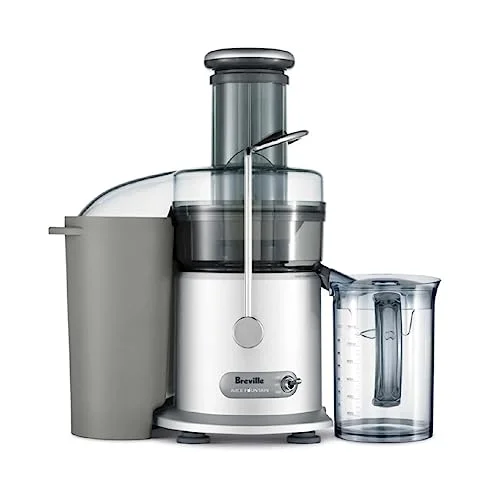
Breville Juice Fountain Plus JE98XL

Best for fast juice from hard fruit and vegetables

Centrifugal·850 watts·2 speeds·3-inch chute

If speed is the point, a centrifugal juicer is the answer, and this is the well-specified middle of the type. Breville pairs an 850-watt motor with two speeds, a titanium-reinforced cutting disc and a stainless-steel filter basket in Italian-made micro mesh, behind a 3-inch chute it says takes whole fruit and vegetables without pre-cutting. The costs belong to the type rather than the brand — a fast motor is loud, the juice carries more foam, and leafy greens are the weak spot of any spinning-basket juicer. The listing gives no jug or pulp-bin capacity and no warranty term.

For apple, carrot and beet juice made fast before work, a centrifugal is the honest choice, and this is a sound one.

Breville Juice Fountain Plus JE98XL centrifugal juicer in silver
Price
$99.95
Check price →
03Best self-feeding

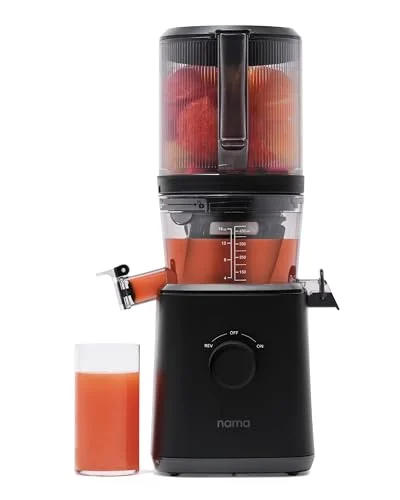
Nama J2 Self-Feeding Cold Press Juicer

Best if you juice daily and the prep is what stops you

Self-feeding hopper·50 RPM·15-year warranty·BPA-free

The J2 changes the routine rather than the recipe. Nama builds the hopper to take a whole recipe at once, and the machine cuts the produce and feeds it to a 50 RPM auger on its own. Nama says it processes leafy greens, lists the parts as BPA-free, and backs the machine with a 15-year warranty. The trade-offs are plain. This is a premium machine, priced like one; Nama publishes no wattage and no hopper or jug capacity; and the identical J2 is sold in black, white and gray as three separate listings, so check all three before you pay.

If you juice every day and the chopping is what stops you, this is the machine that takes it away.

Nama J2 self-feeding cold press juicer in black
Price
$479.00
Check price →
04Best 3-in-1

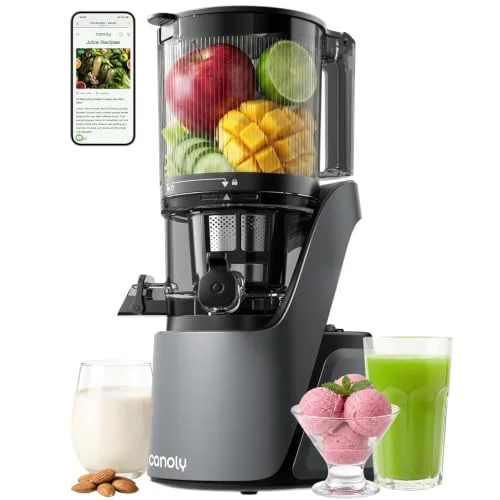
Canoly C16 3-in-1 Cold Press Juicer

Best for whole fruit, nut milk and sorbet

6-inch chute·AC brushless motor·15-year motor warranty·Two strainers

Canoly’s C16 puts a wide chute and a long written warranty below the premium tier. The 6-inch throat takes whole apples, pears and large celery bunches, according to the maker, and a self precut system cuts produce as it feeds. Two strainers, Juice and Sorbet, cover the 3-in-1 claim of juice, nut milk and frozen-fruit sorbet. Canoly backs the AC brushless motor with a 15-year motor warranty and quotes 35 decibels, measured under unpublished conditions, so read it as quiet rather than silent. No wattage, auger speed or capacity is listed, and the 15-year term is for the motor; the listing points to its warranty section for the details.

The pick for whole-fruit juicing and a long motor warranty without paying for a self-feeding flagship.

Canoly C16 3-in-1 cold press juicer in space gray
Price
$189.93
Check price →
05Best budget

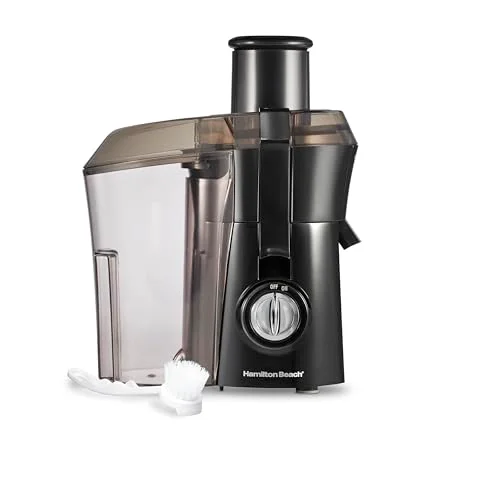
Hamilton Beach Big Mouth Centrifugal Juicer

Best for trying juicing without a big outlay

Centrifugal·800 watts·80 oz pulp bin·3-year limited warranty

The budget pick that still puts its commitments in writing. Hamilton Beach lists an 800-watt centrifugal motor, a 3-inch chute it says fits a whole apple, a bunch of celery or a handful of carrots, an 80-ounce pulp bin, dishwasher-safe removable parts and a 3-year limited warranty — more than most juicers at this tier bother to state. The big pulp bin means longer runs before you stop to empty it. Its limits are the type’s: a spinning basket is loud, the juice is foamier, and greens are a poor use of it. The listing names no speed settings and no juice-container size.

A sensible way to find out whether you will really juice every week. If you do, you will know which way to upgrade.

Hamilton Beach Big Mouth centrifugal juicer in black
Price
$51.28
Check price →
06Budget cold press

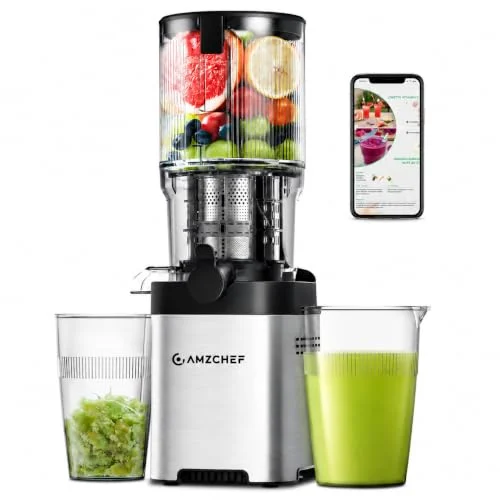
AMZCHEF 5.4-Inch Self-Feeding Cold Press Juicer

Best for trying a slow juicer on a budget

Masticating·5.4-inch chute·60 RPM·Triple strainers

The slow-juicer method and a wide chute, at the budget end. AMZCHEF lists a 5.4-inch chute with built-in cutting blades, which is what lets it call the machine self-feeding: larger fruit and vegetables are cut as they go in, so there is less work at the cutting board. The auger turns at 60 RPM, and three strainers work together to separate pulp from juice. The title describes the juicer as stainless steel without saying which parts. That is where the caveats start: AMZCHEF publishes no wattage, no capacity and no warranty term, and three strainers are more to rinse than one screen.

The easiest way into slow juicing with a wide chute, as long as you accept the gaps in its spec sheet.

AMZCHEF self-feeding cold press juicer in silver
Price
$66.49
Check price →
Our method

How we picked — and what we can’t tell you

What we did

Specs, prices and manufacturer data

We compared published specifications and current Amazon prices for 33 juicer listings — 20 masticating, 11 centrifugal and two electric citrus presses, about 29 distinct models from 22 brands once color variants are folded together — and kept the machines whose makers publish something checkable: chute width, auger speed, motor power, capacity, warranty term. We weighted extraction type, chute width and cleanup above everything else, and counted a written warranty for more than any claim in the product copy. We treated wattage and yield percentages with suspicion: one tells you what kind of juicer it is rather than how well it juices, and the other has no common method behind it.

What we didn’t

We don’t run a testing lab

We do not physically test these juicers, we do not own them, and we do not publish invented scores out of ten. We have no verified rating data for this category either, so this site publishes no ratings of any kind — we would rather show nothing than make something up. What matters most over years of use — how an auger and gearbox stand up to daily carrots, how a fine mesh survives the scrubbing — can only be answered by years of daily use. What we can do honestly is read every specification, compare them, and explain the mechanics behind them.

Go deeper

The guides behind the picks

FAQ

Common questions

Is a cold press juicer better than a centrifugal juicer?

Better at some jobs, worse at others. A cold press, or masticating, juicer crushes produce slowly with an auger, so it is quieter, makes less foam, copes far better with leafy greens, and generally leaves drier pulp. A centrifugal juicer shreds and spins at thousands of RPM: it is faster from start to glass, usually cheaper, and perfectly capable with apples, carrots, beets and other hard produce. If your juice is mostly green, buy a cold press. If it is mostly fruit and roots and you want it quickly before work, a centrifugal does the job.

Does cold-pressed juice keep more nutrients?

It is the category’s most repeated claim, and the marketing runs ahead of the evidence. Slow juicers do whip less air into the juice, which you can see as less foam, and they generally extract more from leafy greens, so the same bunch of kale gives you more juice. The heat argument is weaker than it sounds: produce passes through a centrifugal juicer in seconds. Either way, juicing leaves most of the fiber of whole fruit and vegetables in the pulp bin. Treat any juicer as a way to enjoy produce, not as a treatment for anything, and ask a doctor or registered dietitian about specific dietary needs.

Which type of juicer is best for celery and leafy greens?

A masticating juicer. Leaves are thin and light, and a fast-spinning centrifugal disc tends to fling them into the pulp bin half-juiced, while a slow auger crushes and presses them. Celery brings a different problem: long, stringy fibers that can wrap around an auger and stall it. That is what reverse functions are for — Ninja, YPONE, Aeitto and PSIIDAN all list one to back the auger out and free the fibers. For straight celery juice every morning, a slow juicer with a reverse function is the combination to look for.

Which juicers are easiest to clean?

Look for three things on the listing: dishwasher-safe parts, a small number of parts, and a filter you can rinse quickly. Ninja lists its NeverClog parts as dishwasher safe, and Hamilton Beach says the same of the Big Mouth’s removable parts. Aeitto has dropped the mesh screen entirely on its 3-in-1, which removes the hardest piece to scrub. Machines with two or three strainers ask more of you because there is more to wash. Whatever you buy, rinse it straight after use: wet pulp rinses away easily, while pulp that has dried into a fine mesh needs a brush and patience.

How long does fresh homemade juice keep?

Treat it as a fresh food: refrigerate it right away in a sealed container and drink it soon, ideally the same day. Juice made at home is not pasteurized, and the FDA notes that untreated juice can contain harmful bacteria; it advises children, older adults, pregnant women and people with weakened immune systems to choose pasteurized or otherwise treated juice. Wash produce under running water before juicing and keep the machine clean. Some makers state longer storage for their own containers — NutriBullet says its sealing 27-ounce pitcher keeps juice for up to 48 hours — but color and flavor still fade as juice oxidizes.

Can I trust the juice-yield percentages on listings?

Not as a way to compare machines. Godspeeds claims up to 99% yield, Aeitto and ATSENT 99%, Anybear up to 98.9% and TUUMIIST up to 95%, while centrifugal makers claim 26% or 75% more juice than unnamed other juicers. None of these figures comes with a published method: which produce, how it was prepared, how the pulp was weighed. They cannot be ranked against one another. The reliable part is the general pattern: slow juicers tend to leave drier pulp than centrifugal ones, especially with greens. If yield matters to you, squeeze a handful of pulp after juicing; wet pulp is juice left behind.

Do I need a separate juicer for orange juice?

If orange, lemon and grapefruit juice are all you want, an electric citrus press is the simpler tool. Machines such as the BLACK+DECKER CJ625 and the Elite Gourmet ETS623 use a ridged cone that turns when you press a halved fruit onto it, reversing direction to work the pulp. They are small, quick to rinse, and leave the bitter peel behind. A centrifugal or masticating juicer can handle citrus too, but the thick peel generally has to come off first, and you will clean a whole machine for one glass. If you also want carrot, apple or greens, buy the full juicer.